Introducing GiveLink Docs: The Most Thorough Documentation in Fundraising
We just launched docs.givelink.ai — an AI-native documentation site that sets a new standard for fundraising platform docs. Here's what makes it different.
On this page
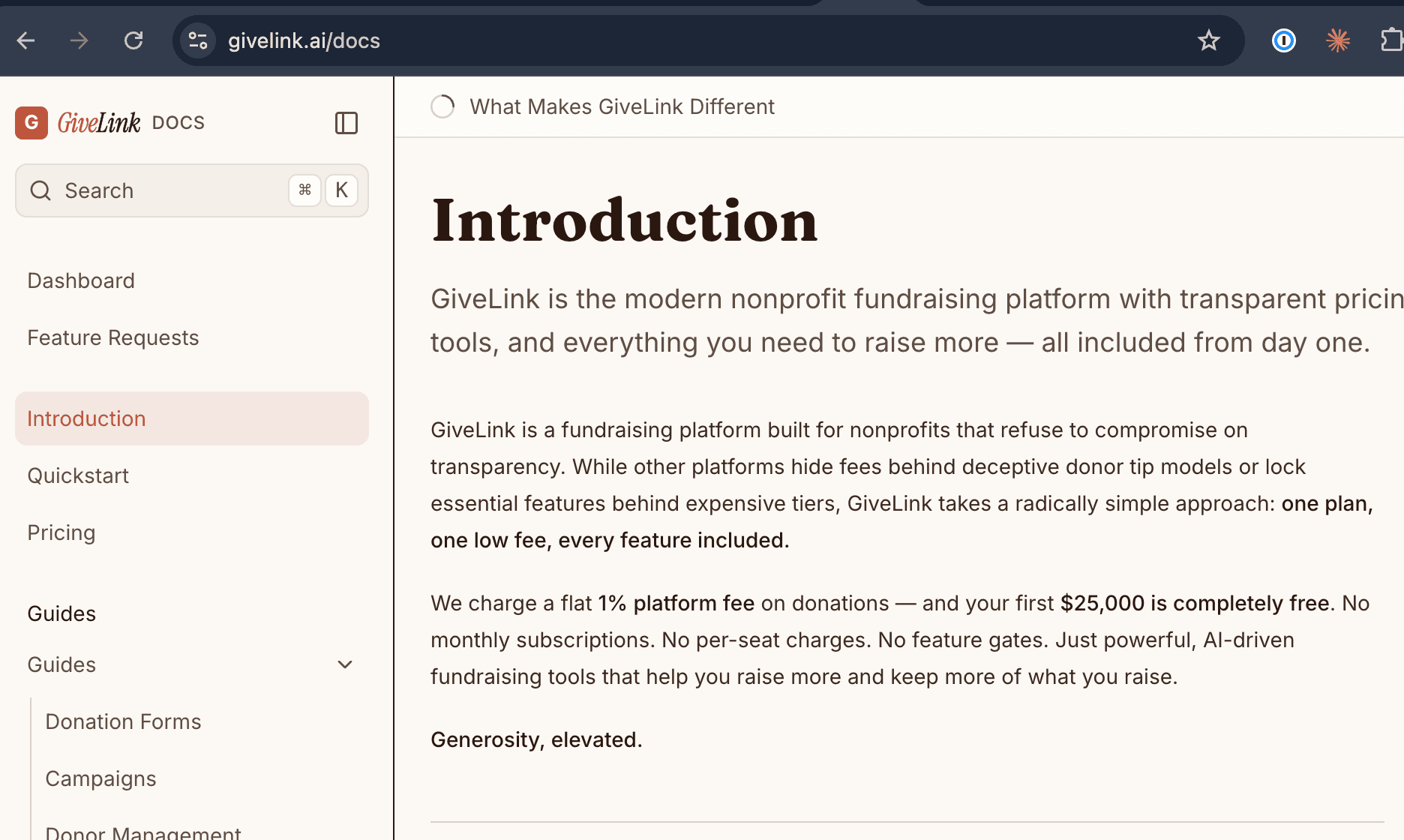
We're proud to announce the launch of GiveLink Docs — and we mean really proud. This isn't a hastily thrown together knowledge base with a few FAQ entries. This is a comprehensive, AI-native documentation platform that we believe sets a new bar for what fundraising software documentation should look like.
Why Documentation Matters This Much
Here's something that frustrates us about the nonprofit tech space: the tools are often powerful, but the documentation is almost always an afterthought. You get a few getting-started guides, maybe a sparse API reference, and then you're on your own. When something breaks at 9 PM on the night of your biggest campaign, you're left digging through community forums or waiting for a support ticket response.
We think that's unacceptable. If we're asking nonprofits to trust GiveLink with their fundraising, the least we can do is give them a resource that answers every question they could possibly have — before they even need to ask.
What's Inside
Our documentation is organized into clear sections that serve different audiences:
- Getting Started — A quickstart guide that gets your first campaign live in under 10 minutes
- Guides — Deep walkthroughs of donation forms, campaigns, donor management, events, memberships, email sequences, and more
- Integrations — Current status for Stripe Connect, Salesforce push-sync, and planned developer surfaces
- API Reference — Status and preview references for coming-soon public developer access
- AI Support — How Coordinator weekly briefing and Stewardship suggestions fit into the launch platform
Every page includes the audience it's written for, the app route it maps to where relevant, and tags for discoverability. We didn't just document what buttons to click — we documented why each feature exists and when you should use it.
AI-Native from Day One
This is where things get interesting. GiveLink Docs isn't just readable by humans — it's designed to be readable by AI support too.
llms.txt: Machine-Readable by Design
We publish a structured llms.txt file that makes the current product surface discoverable by AI assistants, coding tools, and automation platforms. It identifies public developer access as coming soon, so AI support do not mistake planned API, MCP, SDK, OAuth, or sandbox surfaces for launch capabilities.
This isn't a gimmick. As more nonprofits bring on technical consultants or use AI support to customize their setup, having machine-readable docs means those tools can actually help — instead of hallucinating outdated API signatures.
Built-In AI Chat
Don't want to browse through pages? Just ask. We've built an AI chat assistant directly into the docs site. It is grounded in the launch documentation and current status notes. Ask it anything:
- "How do I set up recurring donations with custom frequencies?"
- "What Salesforce records does GiveLink push?"
- "What AI support is included in the 1% platform fee?"
The chat gives you precise answers with links to the relevant documentation pages. It's like having a GiveLink expert available 24/7.
Complete API and Integration Coverage
Public developer access is coming soon, so the API reference now separates preview material from live launch workflows.
For integrations, we've gone especially deep on the launch truth. Stripe Connect is live for payment processing. Salesforce push-sync moves GiveLink donor and donation records into Salesforce. Zapier, public webhooks, public REST API access, MCP, SDKs, OAuth, and sandbox tooling are marked as coming soon.
We Want Your Feedback
This is version one of our docs, and we know there's always room to improve. That's why every page has a feedback mechanism built in. If something is unclear, if an example doesn't work, or if you think a section is missing — tell us. We read every piece of feedback and use it to improve the documentation.
We're not just asking for feedback to be polite. We genuinely believe that the best documentation is built in collaboration with the people who use it. Your experience navigating these docs is data we need to make them better.
What's Coming Next: Featurebase
Speaking of feedback, let's talk about what's next on our development roadmap: Featurebase.
For those who aren't familiar, Featurebase is a product feedback and roadmap platform that lets users submit feature requests, vote on priorities, and see exactly what's being worked on. We're integrating it directly into GiveLink so that every user has a voice in shaping the product.
Why Featurebase Matters for Nonprofits
Most fundraising platforms decide what to build based on what their biggest clients want. That means small and mid-size nonprofits — the organizations that need the most help — get ignored. Their feature requests sit in a support ticket queue and never see the light of day.
Featurebase changes that dynamic completely. Here's what it will look like:
- Public roadmap — See exactly what we're building, what's in progress, and what's shipped. No black boxes.
- Feature voting — Every organization gets a voice. Vote on the features that matter most to you, and watch them climb the priority list.
- Changelog — Every release gets a detailed changelog entry so you always know what's new and how it affects your workflow.
- Direct feedback loop — Submit ideas, report issues, and have a real conversation with the GiveLink team about what you need.
How We'll Use It
We're planning to integrate Featurebase into the GiveLink dashboard itself, so you don't have to leave the app to submit feedback or check the roadmap. When you're using a feature and think "this would be so much better if it also did X," you'll be able to submit that thought in two clicks.
We'll also tag every documentation page with its corresponding Featurebase category, so feedback on docs flows directly into the right product bucket. If you're reading the campaign docs and realize something is missing, your feedback goes straight to the campaigns team — not into a generic inbox.
Transparency All the Way Down
Featurebase fits perfectly with GiveLink's core philosophy. We're transparent about our pricing — a flat 1% with no hidden fees. We're transparent about our technology — open API, full documentation, machine-readable specs. And now we'll be transparent about our roadmap too.
You'll be able to see exactly why we prioritize certain features, how community votes influence our decisions, and when you can expect the features you've requested. No more wondering if your feedback went into a void.
A Standard Worth Setting
We built GiveLink because we believe nonprofits deserve better tools. The same philosophy applies to documentation. You deserve docs that are thorough, searchable, AI-friendly, and constantly improving. You deserve a feedback loop that actually listens. And you deserve a product roadmap you can see and influence.
If you haven't checked out the docs yet, head over to docs.givelink.ai and take a look. Try the AI chat. Browse the API reference. And most importantly — tell us what you think.

Salesforce consultant turned nonprofit tech builder. Believes every dollar of generosity should reach its intended destination.
More from product

The website went quiet this summer. The product didn't.
If the blog looked frozen this summer, the product was anything but. Here's an honest rundown of the fifty-plus improvements we shipped between June and September, from turning the AI on for every organization to making the money math accurate to the cent.
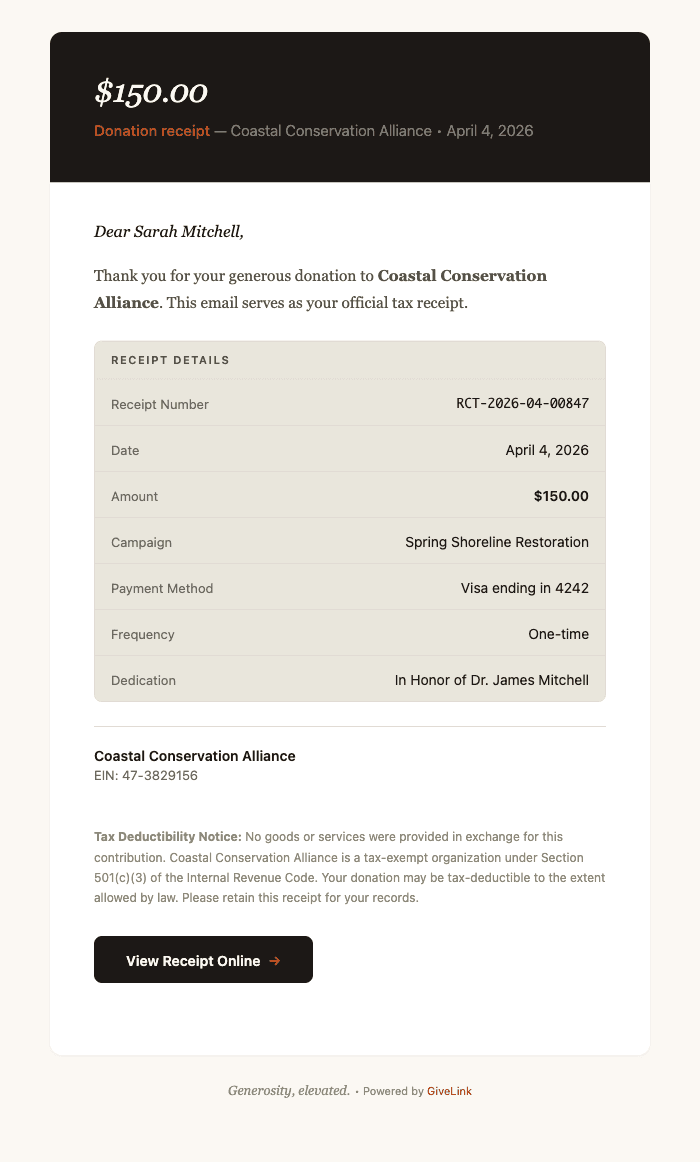
Why Your Fundraising Emails Look Like They Were Sent by a Robot (And Why We Fixed Ours)
Most nonprofit platforms treat email as an afterthought — generic templates that undermine the trust you've spent years building. We built a unified design system for every email GiveLink sends, because every touchpoint is a brand moment.
Welcome to the GiveLink Blog
We're launching a blog to share what we're building, why we're building it, and what we're learning along the way.